

Hybrid work has changed what people need and how they behave while in the office, but many workplaces are still being planned around assumptions that no longer reflect how employees actually work.
Understanding how people interact with the space is key when you have to make important decisions. With the latest trends in RTO and hybrid, people don't come into the office at the same frequency, teams don't always choose the same days, and employees don't all come in for the same reasons.
Some are looking for collaboration and connection, while others need a quiet place to focus. A meeting room designed for eight people may regularly be used by two, while a collaboration area may be packed on Tuesdays and nearly empty on Fridays.
The office has become more of a destination than a default. Employees are making more intentional decisions about when they come in and what they need from the workplace when they do. For Workplace Strategists, this creates a new challenge. It's no longer enough to know how many people are coming into the office. The bigger question is whether the workplace actually supports what they're coming in to do.
Designing a successful hybrid workplace starts with understanding how employees actually behave and using that utilization data to make better decisions about space, capacity, collaboration, team neighborhoods, and the overall workplace experience.
Hybrid Work Isn't One Behavior
We often talk about hybrid work as if everyone follows a similar pattern, but the reality is way more complex.
One team may come in three days a week and spend most of its time collaborating in shared spaces. Another may visit less frequently but depend heavily on meeting rooms when they do. Some employees may spend most of their day at a desk, while others move between meetings, focus areas and other spaces and, others come to an office to have social interaction with peers.
Even two teams with the same headcount can have completely different workplace needs.
This is where planning around averages can become limiting. Knowing that employees come into the office an average of three days a week doesn't tell you which days they choose, how long they stay, what spaces they use and why, or what they need once they're there. It also doesn't tell you whether the teams that need to collaborate are actually coming in on the same days.
For Workplace Strategists, understanding those differences creates a much stronger foundation for design. Instead of planning around what employees are expected to do, teams can start looking at what is actually happening across the workplace.
Look Beyond How Much Space You Have
One of the most common questions in workplace planning is whether an organization has enough space. In a hybrid environment, a better question may be whether it has the right mix of space.
An office can technically have plenty of capacity and still create a frustrating experience. There may be hundreds of available desks across a building while employees struggle to find a small meeting room. Large conference rooms may be regularly occupied by one or two people because smaller spaces aren't available. A floor may have plenty of focus rooms while collaboration areas experience more demand.
In these situations, adding more square footage doesn't necessarily solve the problem. The issue may be how the existing space is distributed, and this is where utilization data can play a key role.
Consider a company planning to reorganize its team neighborhoods. Badge data may show that 200 employees entered the office on Tuesday, but it doesn't tell Workplace Strategists which teams spent time together, which spaces they used, or where collaboration actually happened.
With more detailed utilization and workplace behavior data, the picture becomes clearer. For example, two departments assigned to different floors may regularly use the same collaboration areas or meeting spaces. Understanding these patterns can help Workplace Strategists identify opportunities to bring teams closer together, rethink adjacencies, and create neighborhoods that better support how employees actually work.
Instead of organizing space based only on headcount, assigned departments, or assumptions about collaboration, teams can make decisions based on observed workplace behavior.
The goal isn't to make every area busy. It's to create a mix of spaces that better reflects what employees actually need and what they will use.
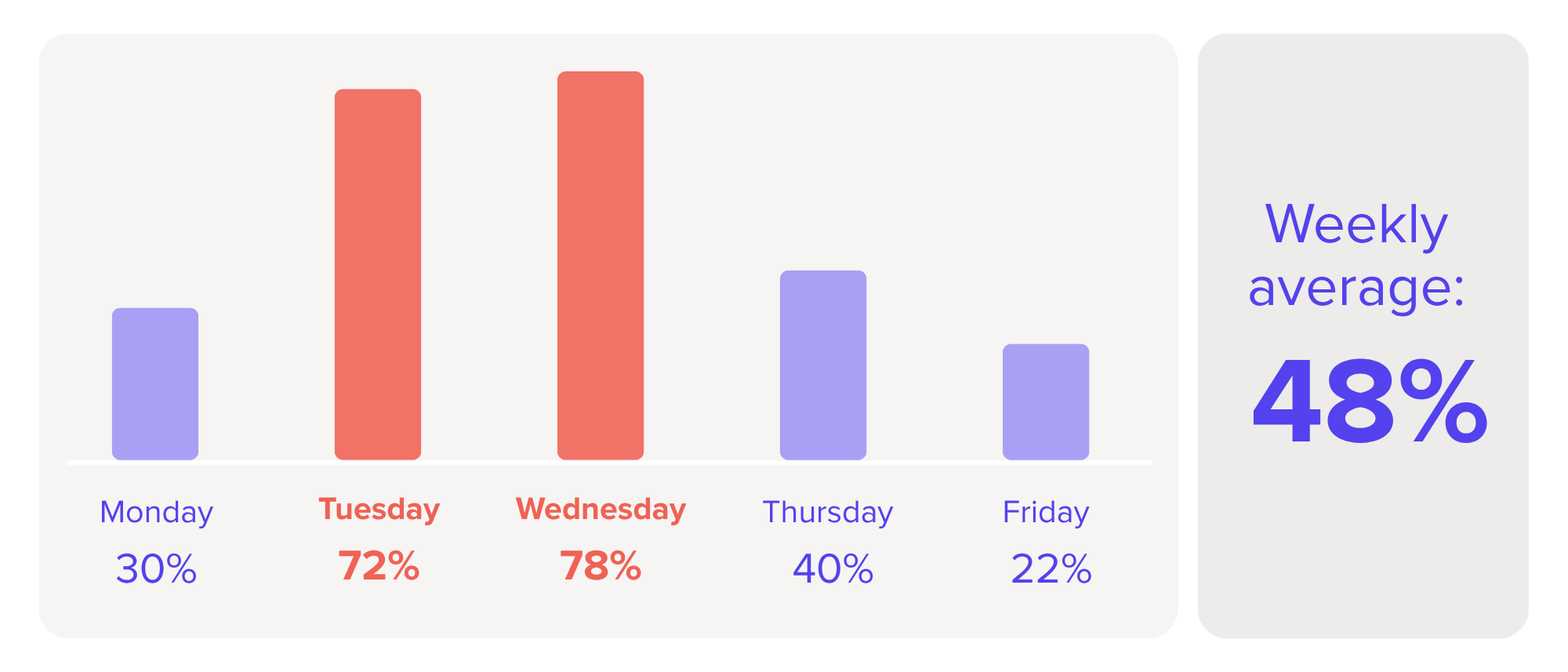
Hybrid work makes it important to understand not only how much space is being used, but when demand occurs. An office might average 45% utilization across the week and still feel crowded on Tuesdays and Wednesdays. The average isn't wrong, but it doesn't tell the whole story. Looking at peak days and where demand concentrates helps Workplace Strategists make better decisions about capacity without planning for an extreme at either end.
The same applies at the team level. One department may have assigned space that sits underused most of the week, while another regularly feels pressure because employees tend to come in on the same days. Two teams with the same headcount can have very different needs depending on how often they come in, how they use the office, and the types of spaces they rely on. Understanding those patterns, including which teams are actually collaborating and spending time together, can help Workplace Strategists make better decisions about team neighborhoods, adjacencies, allocations, and opportunities to better align teams around the days they benefit most from being together.
Design Is Not the End of the Process
A workplace redesign shouldn't be considered finished just because the project is complete. If desks were removed, collaboration areas added, or teams relocated, Workplace Strategists should be able to understand what happened next. Are employees using the new spaces? Did the change improve utilization? Did it support the collaboration or focus work it was designed for? Did it solve the original problem, or simply move it somewhere else?
Having actual data also makes workplace decisions easier to defend. When a department requests more space, Workplace Strategists can look at utilization patterns before deciding whether additional square footage is necessary or whether existing space could be used more effectively. This helps reduce decisions based on opinions, assumptions, or individual preferences and creates a stronger foundation for conversations with leadership. It also helps teams understand the potential impact on operating expenses (OPEX), justify investments, and measure whether workplace changes or policies are actually delivering the intended results.
Looking at behavior before and after a change helps teams understand what worked and what needs to be adjusted. As hybrid behaviors continue to evolve, the workplace can evolve with them. It creates a more continuous approach to workplace strategy: understand, design, measure, learn and improve.
Design Around What People Actually Do
Hybrid work has made workplace planning more complex, but it has also created an opportunity to make better, more informed decisions. When Workplace Strategists understand why people come in, when demand is highest, how teams use space, where collaboration happens, and which environments are actually supporting employees, they can design around real needs rather than assumptions.
The goal isn't to create a workplace that is full all the time. It's to create one that works well when people are there and can continue to adapt as behaviors and needs change.
The best workplace decisions aren’t just informed, they’re defensible and measurable. When redesigns, restacks and space investments are grounded in actual utilization and behavioral data, Workplace Strategists can clearly demonstrate why a decision was made and measure whether it delivered the intended result. Move beyond assumptions and point-in-time occupancy. Build the evidence to make the right decision, prove its impact and continuously improve what comes next.
Do you want to learn more? Talk To Sales