

Every workplace transformation project begins with a vision.
Organizations want to improve employee experience, optimize real estate costs, support hybrid work, increase collaboration, modernize their workplace, or prepare for future growth. These goals are often well-intentioned and supported by significant investments of time, resources, and leadership attention. Yet many workplace transformation projects encounter challenges long before construction begins, furniture is moved, or policies are implemented.
Project timelines slip. Stakeholders become misaligned. Departments develop competing priorities. Success metrics change halfway through the initiative. By the time the project is complete, leadership teams are left asking an uncomfortable question: Did we actually achieve what we set out to accomplish?
The most successful workplace transformations avoid this problem by focusing on alignment before action.
Before redesigning a floorplan, consolidating office space, introducing a new workplace strategy, or investing in employee experience initiatives, organizations need a shared understanding of where they are today, where they are trying to go, and how they will measure success along the way.
In other words, every workplace transformation needs a baseline before it needs a blueprint.
Workplace Transformation Is a Team Sport
One of the biggest challenges facing workplace leaders is that transformation projects rarely belong to a single department.
Corporate Real Estate teams are often focused on portfolio optimization, utilization, and long-term space planning.
Facilities teams prioritize operational efficiency, maintenance requirements, and service delivery.
HR leaders are concerned with employee experience, engagement, attraction, and retention.
IT teams must ensure technology infrastructure supports evolving workplace needs.
Finance leaders focus on cost management, investment decisions, and return on investment.
Executive leadership is ultimately looking for business outcomes that support organizational goals.
Each stakeholder group enters the project with legitimate priorities. The challenge arises when these priorities are not aligned from the beginning. Without alignment, workplace projects can quickly become reactive. Decisions are made based on individual perspectives rather than shared objectives. Departments begin optimizing for their own success metrics rather than the success of the organization as a whole.
The first step in any workplace transformation initiative should be creating a common framework that answers several key questions:
- Why are we undertaking this project?
- What business outcomes are we trying to achieve?
- How will success be measured?
- Who owns key decisions?
- What data will guide those decisions?
- What does success look like one year after implementation?
When these questions are answered collectively, organizations establish a strong foundation for the project ahead.
Why Baseline Data Matters
Many organizations begin measuring workplace performance only after changes have been made.This creates a significant challenge. Without a clear understanding of how the workplace was functioning before the transformation, it becomes difficult to evaluate whether the project delivered meaningful results.
Did utilization improve?
Did employees adopt the new workplace design?
Did collaboration increase?
Did employee experience improve?
Did the organization reduce costs while maintaining workplace effectiveness?
Without historical data, workplace leaders are often forced to rely on anecdotal feedback, assumptions, or isolated snapshots of performance.This is where workplace intelligence becomes essential. Before any workplace changes occur, organizations should establish a comprehensive baseline of how employees are currently using their spaces.
This baseline should include metrics such as:
- Occupancy trends
- Space utilization rates
- Meeting room performance
- Collaboration space usage
- Employee movement patterns
- Dwell time by space type
- Peak demand periods
- Underutilized areas
- Building and floor-level performance
These data points provide a factual picture of workplace performance before any changes are introduced. The result is a benchmark that can be referenced throughout the entire transformation journey.
Measuring Before, During, and After
One of the most valuable aspects of workplace intelligence is the ability to measure change over time. Many workplace projects are treated as a single event. A redesign is completed, a policy is launched, or a consolidation occurs. The project team moves on to the next initiative.
The most effective workplace leaders take a different approach. They view workplace transformation as an ongoing process that requires continuous measurement and refinement.
InnerSpace utilization and behavioral data allows organizations to evaluate workplace performance at every stage of the transformation lifecycle.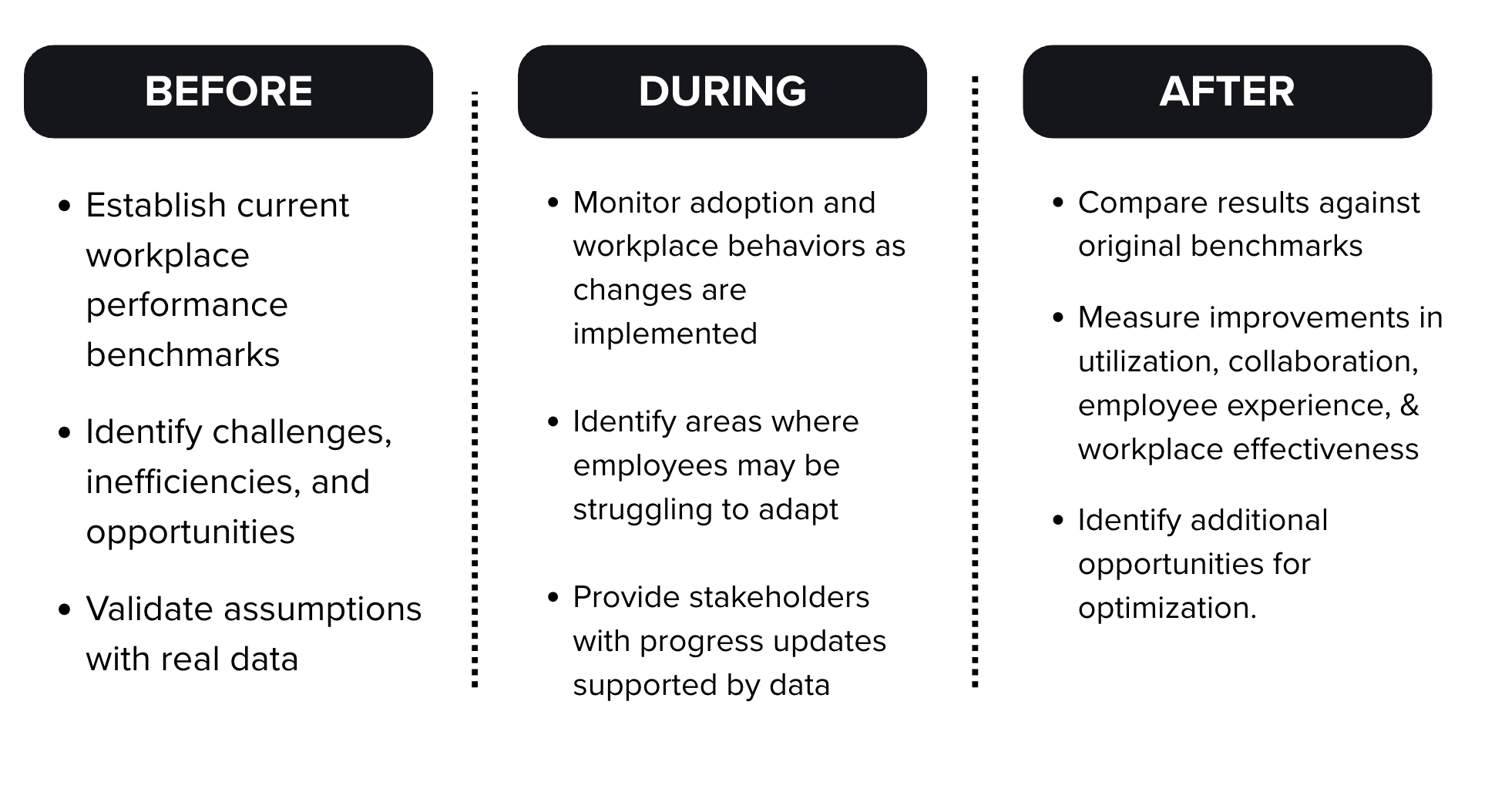
This approach transforms workplace projects from one-time initiatives into continuous improvement programs.
A Practical Workplace Transformation Timeline
While every project is different, a structured approach can help keep stakeholders aligned and projects on track.
Phase 1: Discovery and Alignment (Months 1-2)
- Bring key stakeholders together
- Define project objectives
- Establish governance structures and decision-making responsibilities.
- Agree on success metrics
- Document business requirements
Phase 2: Baseline Measurement (Months 2-4)
- Collect workplace utilization and behavioral data
- Analyze current workplace performance
- Identify high-performing and underperforming spaces
- Develop benchmark reports
- Align stakeholders around findings
Phase 3: Strategy and Design (Months 4-6)
- Use workplace intelligence to inform planning decisions
- Develop workplace concepts
- Evaluate design options against business objectives
- Finalize implementation plans
Phase 4: Implementation (Months 6-12)
- Execute workplace changes
- Maintain regular stakeholder reviews
- Track adoption and workplace performance
- Address issues as they emerge
Phase 5: Post-Implementation Optimization (Months 12+)
- Measure outcomes against original benchmarks
- Identify lessons learned
- Implement continuous improvement initiatives
- Establish an ongoing workplace measurement program.
A Workplace Transformation Checklist
Before moving forward with any major workplace initiative, leadership teams should be able to answer the following questions confidently:
Business Alignment
✓ Have we clearly defined the business problem?
✓ Are stakeholders aligned on desired outcomes?
✓ Have we established measurable success criteria?
Stakeholder Alignment
✓ Have CRE, Facilities, HR, IT, Finance, and executive leadership been engaged?
✓ Are roles and responsibilities clearly defined?
✓ Is there agreement on decision-making authority?
Data Readiness
✓ Do we have baseline utilization data?
✓ Do we understand how employees currently use the workplace?
✓ Can we measure future changes against historical performance?
Measurement Strategy
✓ Have we defined key performance indicators?
✓ Do we have a plan for reporting progress?
✓ Will we measure outcomes before, during, and after implementation?
If the answer to any of these questions is no, additional preparation may be required before launching the project.
Alignment Creates Confidence
Workplace transformation projects often represent significant investments. Leaders need confidence that decisions are being made based on evidence rather than assumptions.
Alignment provides clarity.
Data provides confidence.
Together, they create the foundation for successful workplace change.
Organizations that establish stakeholder alignment early and leverage workplace intelligence throughout the project lifecycle are better positioned to make informed decisions, maintain momentum, and achieve measurable outcomes.
The most successful workplace transformations are not defined by new furniture, redesigned floorplans, or updated policies. They are defined by their ability to support people more effectively while delivering meaningful business value.
Before launching your next workplace initiative, take the time to establish alignment, capture baseline performance data, and define how success will be measured. The organizations that do this well are not only more likely to complete projects on time and on budget, they are far more likely to create workplaces that continue to evolve and improve long after implementation is complete.