


Why Continuous Improvement Requires Continuous Workplace Intelligence
There is a question I keep coming back to when I talk with CEOs, corporate real estate leaders and workplace teams: Why do we continuously measure almost every critical part of a business, but still manage the workplace in snapshots? We see a dedicated monitoring strategy across all key departments - businesses monitor sales daily, supply chains are continuously measured. Manufacturing operations are constantly monitored for quality, efficiency and performance, yet when it comes to the workplace, one of the largest operating and capital investments for many enterprises, CRE leaders often take a very different approach.
A lease renewal comes up, so a utilization study is commissioned. A headquarters redesign is proposed, so occupancy is measured. Leadership changes its hybrid policy, so they look at badge data. A consolidation is being considered, so a lengthy (and expensive) workplace study is commissioned. Information is collected when there is a question to answer and then the study ends and they move onto the next question or challenge.
There are other demonstrated ways to think about this, and one of the best examples comes from an industry far removed from corporate real estate: automotive manufacturing. Toyota's Production System (TPS) has been studied around the world for its approach to efficiency and continuous improvement. Toyota describes its system as one focused on making work easier for people, eliminating waste and continually pursuing better ways of working. Its employees practice incremental kaizen every day. TPS itself has evolved over generations through experimentation, learning and improvement.
InnerSpace doesn't use or replicate the Toyota Production System verbatim as we know that building cars and managing workplaces are obviously very different things. But there is a principle behind Toyota's philosophy that I believe has enormous relevance for the future of workplace management: You can't continuously improve something you only occasionally understand.
This idea is particularly meaningful to me because it connects to work I began more than two decades ago. My PhD research examined collaborative work and the technologies designed to support it. One of the fundamental observations was that work is dynamic. People don't operate in one fixed mode. They move between individual and group work, synchronous and asynchronous activity, and different tools, tasks and processes.
One of the lessons from that research was deceptively simple: observe how people actually work before deciding what they need. Rather than beginning with one theoretically perfect technology, my research developed a systematic process that started by observing real work, identifying requirements from those observations, understanding different workstyles, evaluating possible approaches and then designing technology around those actual needs. That led to a principle I've carried with me throughout my career:
Don't design around how you assume people work. Build an evidence loop that reveals how work actually happens, and use that evidence to improve the system.
Today, at InnerSpace, we're applying a similar philosophy to the physical workplace.
Lesson One: You Can't Improve What You Don't Continuously Understand
Toyota's idea of kaizen isn't based on occasionally stopping operations to determine whether there might be a better way to build a car. Improvement is embedded into the operating philosophy. Toyota says TPS itself evolved through years of trial and error, and that employees continue to implement incremental improvements every day.
Now consider how we traditionally manage corporate workplaces. A conventional utilization study can tell you a lot about what happened during the period being measured - but today's workplace is anything but static. Monday can look very different from Wednesday, the morning can look very different from the afternoon, marketing can use space differently from engineering and the week before a holiday can look nothing like a normal business week. Then add to the mix reorganizations, hiring, changing hybrid policies, lease events and workplace redesigns.
The workplace is a dynamic system, yet we're often trying to understand it through static measurement. This is something I see repeatedly in conversations with enterprise workplace leaders. The problem isn't necessarily that they have no data. It's that the available data doesn't always provide enough historical or behavioral context to answer the question that has suddenly become important. There is also a looming limitation to snapshot workplace data - you can’t go back and collect yesterday. If leadership decides six months from now that it wants to understand how employee behavior changed following a workplace redesign,the baseline needs to already exist. If it doesn't, it's gone.
That's why I believe the future of workplace management starts with a different premise: establish the data foundation first. InnerSpace uses an organization's existing enterprise Wi-Fi to capture workplace utilization data without requiring dedicated occupancy sensors or new hardware. This makes it possible to build a growing historical picture of how the workplace is being used, rather than beginning a new data-collection exercise every time another question emerges.
Continuous improvement starts with continuous understanding
Lesson Two: Make Waste Visible Before Trying To Eliminate It
Another foundational idea within TPS is eliminating waste. Toyota describes this not only in terms of muda (non-value-added activity and waste), but also mura (unevenness or irregularity), and muri (overburden). The broader objective is to create a system that is efficient while making work easier for people and there is an interesting parallel in corporate real estate.
When we talk about workplace waste, the conversation can quickly become overly simplistic: How many desks are empty? That's not the question I would start with. An empty desk at 10 a.m. on a Friday doesn't necessarily mean you have too much real estate. It is important to also consider that waste can take many forms.
It could be three floors being cleaned and maintained every day despite consistently low demand. It could be meeting rooms sitting empty while employees struggle to find smaller collaboration spaces. It could be one department occupying substantially more space than its actual patterns require, while another team faces severe pressure on peak days.
It can also be millions of dollars invested in a workplace redesign that doesn't change how people actually use the space. Sometimes what looks like unused space, may actually be essential capacity for peak demand. That is why visibility has to come before optimization.
You need to understand averages and peaks, you need to see differences between buildings, floors, zones, days and time periods, and increasingly, you need to understand behavior, not simply presence. Only then can leadership distinguish genuine excess from necessary capacity.
Lesson Three: Occupancy tells you what happened. Behavior helps explain why.
Toyota's concept of jidoka, which Toyota describes as “automation with a human touch”, is especially interesting in this context. When an abnormality occurs, the system makes the problem visible so it can be addressed and prevented from recurring. Toyota is explicit that technology itself isn't responsible for continuous improvement - human judgment remains essential. That resonates deeply with how I believe workplace technology should operate. Technology shouldn't make workplace decisions for leaders, it should make patterns visible so leaders can make better decisions.
This is a very important consideration as AI becomes embedded in more workplace technologies. Counting people is useful. Knowing that a floor reached 63% utilization tells you something, but it doesn't necessarily tell you how well that floor is working. You need answers to questions like;
- Where are people spending their time?
- How long do they stay?
- Which spaces attract repeat use?
- Where does demand concentrate?
- What happens on peak days?
- How do teams move through the workplace?
- Did behavior change after the organization redesigned the floor?
That is the difference between occupancy and behavioral intelligence. Whereas occupancy asks “was the space used?”, behavioral intelligence asks “how is the workplace actually working?”.
This also connects directly back to my academic work. My research found that collaborative work involves frequent transitions between different workstyles and concluded that the systems supporting people need to accommodate those different modes and transitions. Twenty-two years later, I see the same challenge playing out in physical space. A floor isn't simply occupied or unoccupied, it is people moving between focus work, meetings, collaboration and individual activity. Different teams behave differently and those patterns change over time. Understanding that behavior gives workplace leaders something much more useful than another occupancy percentage - it provides evidence about whether the environment is actually supporting the work people are trying to do.
Behavioral intelligence can surface patterns that highlight where friction exists or where resourcing does not match utilization in spaces like meeting rooms. When you are capturing data across your entire footprint, you are capturing not only a historical benchmark to compare against, but also patterns that indicate where adjustments can be made that can significantly impact performance and productivity. It can also indicate where waste is occurring and where significant cost savings can be found.
Take for example the impact of adjusted cleaning schedules. Our clients are leveraging utilization data to indicate actual use of facilities and then making adjustments to cleaning schedules and heating and cooling settings based on actual use of these floors and buildings by their teams. This represents a significant cost savings each year.
Lesson Four: Have The Information Ready When The Business Needs It
The second pillar of TPS is Just-in-Time: making what is needed, when it is needed and in the amount needed. Toyota's system synchronizes production so that the right resources are available when demand requires them without creating unnecessary inventory and waste.
While I certainly understand that workplace management is not automobile manufacturing, and I wouldn't suggest applying ‘Just-in-Time’ literally to CRE, the principle raises an interesting question: What workplace intelligence does the organization need, where does it need it, and when does it need it?
An enterprise with 100 buildings doesn't necessarily need the same intensity of analytics in all 100 buildings every day. A global headquarters undergoing major transformation may require ongoing analysis. A smaller regional location might require deeper analysis only when its lease comes up for renewal. Another building may suddenly become important because leadership is considering a consolidation. The opportunity is to capture workplace data broadly enough that the historical foundation exists, while giving organizations flexibility in when and where they turn that data into deeper intelligence.
Imagine an enterprise with 100 locations. It continuously analyzes its 15 most strategically important campuses, then leadership begins considering a lease decision at Building 63.
Under the traditional study model, that decision can trigger a traditional approach to the problem: establish the study, deploy the measurement method, wait for enough representative data, analyze it and then begin making decisions. But what if the historical data were already there?
Suddenly, the organization isn't starting its investigation on the day the question is asked. It can look backward and understand how that workplace has behaved over time. You don't need to analyze everything all the time. But you can't analyze yesterday if you didn't capture yesterday.
Lesson Five: Create A Workplace Kaizen Loop
This is what I think is the most important lesson workplace leaders can take from the philosophy of continuous improvement. Stop treating workplace measurement as the end of a project.
Make it part of the management process.
A simple workplace improvement loop might look like this:
.png?width=2000&height=941&name=James%20leadership%20article%20workplace%20improvement%20loop%20(1).png)
That sounds straightforward, but it represents a significant change from the way many organizations have historically approached workplace transformation.
Let’s look at a redesign project as an example. A company studies a floor and discovers that employees need more collaboration space. The organization spends significant capital redesigning it and then makes it available to their teams. What happens next? Too often, the project is considered complete once the redesign is done and teams begin using the new space.
A continuous-improvement mindset asks another set of questions.
- Did people actually use the new collaboration spaces?
- Did dwell patterns change?
- Did the pressure on meeting rooms decrease?
- Did previously underused areas become more productive?
- Did the redesign solve the problem we thought it would solve?
- And did it create another problem we didn't anticipate?
That last question is important. One of the conclusions from my doctoral work was that every design decision involves trade-offs. Different technology choices could improve efficiency, reliability, functionality or usability in different ways. The purpose of analysis wasn't necessarily to reveal one universally correct answer, it was to make those trade-offs visible enough that people could make reasoned decisions. Workplace decisions are no different.
Reducing a headquarters from 12 floors to 10 may create enormous financial value, but utilization alone isn't enough to tell you whether 10 floors is right. You also need to understand peaks, team patterns, meeting demand, employee experience, operational constraints and future requirements. The goal isn't simply less space, it's better-performing space. Lowering the cost of learning changes what is possible
There is another connection between my research and the work we're doing at InnerSpace that I think is particularly important. My thesis examined the tension between analytical rigor and practical usability. A perfect model that is prohibitively difficult or expensive to use, doesn't necessarily help people make better everyday decisions. Useful analysis has to be rigorous enough to improve the decision while practical enough that people will actually use it. That same tension has existed in workplace measurement for years. If gathering reliable utilization data requires deploying thousands of sensors, commissioning a lengthy study and repeating that process every time another question arises, organizations naturally measure selectively.
The cost and friction of measurement influences how frequently you can learn. That's why leveraging infrastructure that enterprises already have matters. When the cost and complexity of establishing the data foundation falls, workplace measurement can move from being an occasional project to an ongoing management capability. This fundamentally changes what becomes possible. The strategic approach to managing CRE goes from individual workplace projects to workplace management
We're reaching an important point in the evolution of workplace strategy. Hybrid work is no longer simply a temporary disruption organizations are waiting to resolve. JLL's 2026 Global Occupancy Planning Benchmark, based on 84 organizations representing 716 million square feet globally, describes structured hybrid work as increasingly established. It also reports that improving space-data accuracy has risen to the number-two CRE priority as organizations prepare their data foundations for more advanced and AI-enabled planning. I think that's significant.
For years, the workplace industry has been searching for the new normal and I don't think the objective should be to find one. The next generation of workplace strategy isn't about designing the perfect workplace and declaring the job finished. It's about creating an operating model capable of continuously adapting and evolving just as their teams and business needs do.
People change. Teams change. Technology changes. Policies change. Business priorities change. The workplace needs to change with them.
I challenge you to change the fundamental question from “did we design the right workplace?”, to “do we have the information and operating model to keep making our workplace better?”. Your workplace should never be finished.
This may ultimately be the most valuable lesson I take from Toyota. Toyota doesn't describe TPS as a system perfected decades ago, it describes a philosophy that continues to evolve through kaizen. Toyota's broader vision captures that mindset simply: “There is always a better way.”
That's how I believe we need to start thinking about workplaces. For too long, we've managed them as a sequence of projects.
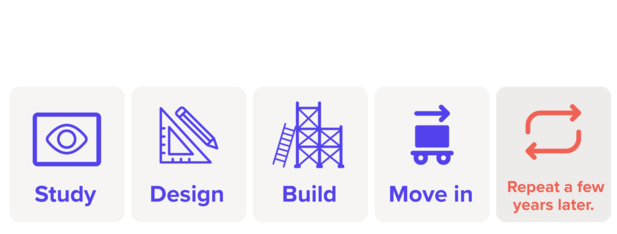
But the workplace is never finished because the organization it supports is never finished.
We now have the ability to build something better: a continuous evidence loop between how people work, how the workplace performs and what leaders do next. My research more than two decades ago began with observing how people actually worked and using that evidence to design technology that better supported them. Fast forward to today and I believe the same principle should guide how we manage physical workplaces.
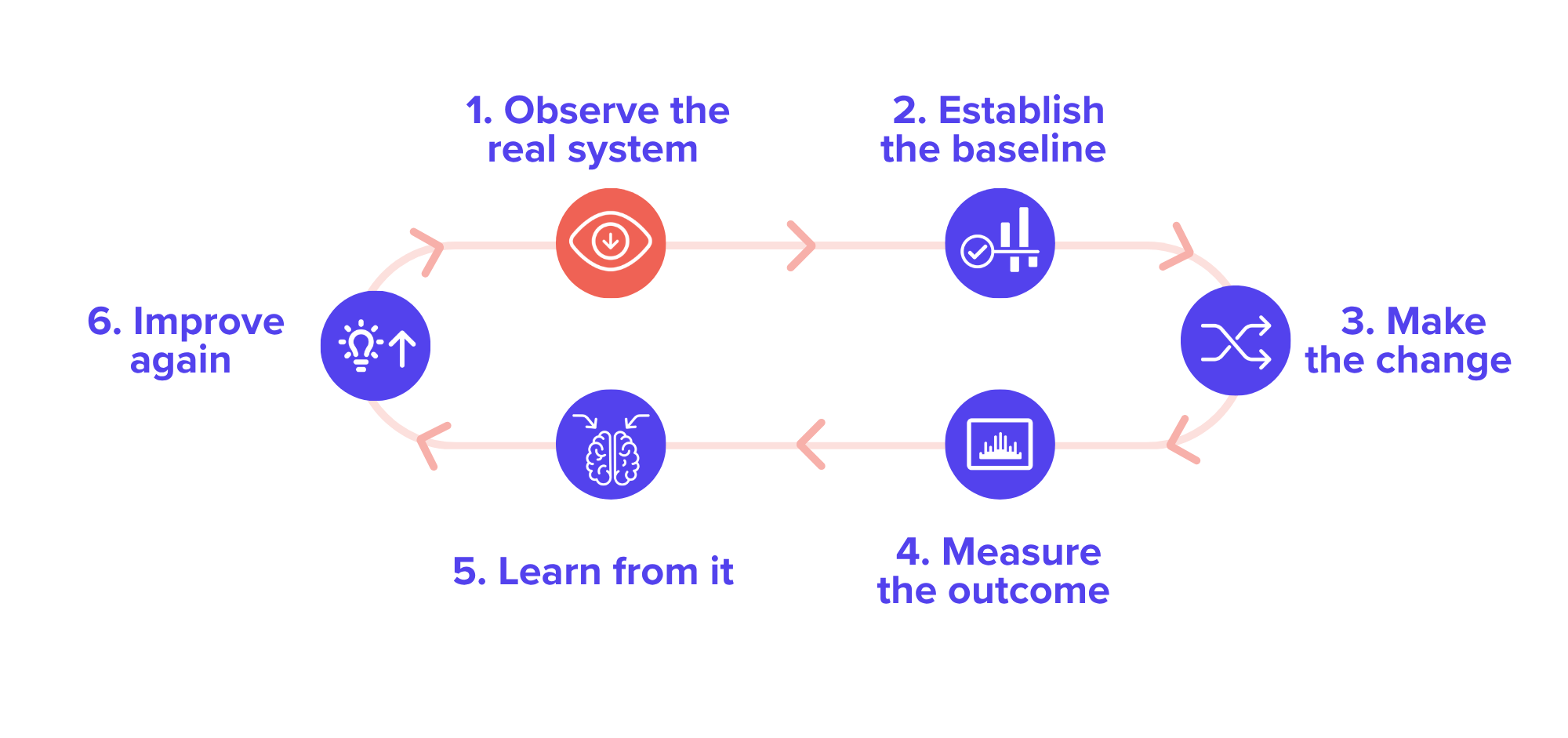
Because continuous measurement creates continuous learning and continuous learning is what makes continuous improvement possible.
Let me know what you think - james@innerspace.io
About James Wu - James is the CEO and Co-Founder of InnerSpace. With a Ph.D. in Computer Science from Queen’s University, he combines deep academic knowledge with hands-on leadership in product-driven organizations. His commitment to enhancing human experiences through technology has earned him multiple design awards and a reputation for driving innovation in the digital space.